

Latest update: 25 June 2026
Key takeaways:
- Global supply chains remain under pressure, driven by geopolitical disruptions, rising costs, and constrained capacity.
- Elevated fuel and insurance costs are reducing shipping reliability and increasing the need for longer-term freight planning.
- While supply chain risks persist, shifting trade patterns may create opportunities for exporters to strengthen market position and expand market share.
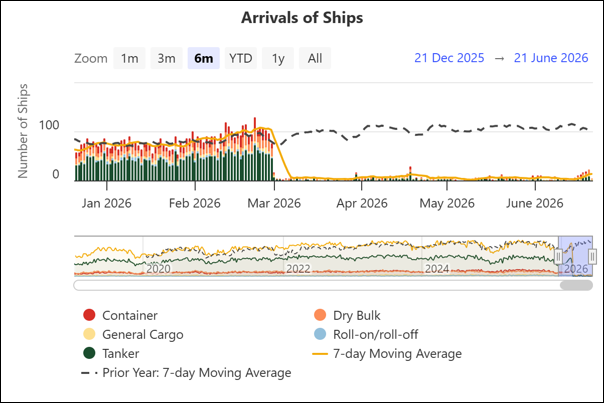
- Ship movements can be seen to be increasing as a ceasefire between the US and Iran remains in place and talks continue after the signing of the memorandum of understanding by President Donald J. Trump and Iran’s President, Masoud Pezeshkian.
- NAB reported that over 6.5 million barrels of oil per day has exited the Strait over the last three days. Based on these numbers, replenishment of oil stock supply and lower prices are essential to support recovery from the world’s largest oil and gas supply shock in history (Rystad).
 Source: IMF | PortWatch: A Partnership with Oxford University
Global and national trends
- Shipping container rates are continuing to rise and jet fuel costs remain elevated despite short-term easing (USD$70 per barrel above 2024-25 average).
- Freight carriers are increasingly responding to higher operating costs amid ongoing global uncertainty along common shipping routes by prioritising capacity allocation toward more profitable and commercially resilient destinations.
- Meanwhile, Global shipping schedule reliability also remains below historical norms, with vessel congestion across the Middle East and key trans-shipment hubs further constraining global freight capacity.
- Global container freight rates recorded a 23% increase over the month of May 2026 (until the 28th), reaching USD$2,800 per 40-foot container, due to higher freight rates on Asian to European trade route.
- Jet fuel prices remain elevated at USD$163 per barrel, despite a slight easing trend.
- The global average jet fuel price has fallen 22% across the month of May 2026, however, prices remain 57% higher than last years average (year to date).
- Ongoing disruptions across major shipping corridors, re-routing to avoid conflict-impacted regions and congestion at key ports, are increasing fuel consumption, voyage times and scheduling pressures. Carriers have begun to implement fuel and emergency bunker surcharges, and operational adjustments including slow steaming to manage costs and preserve network efficiency.
- Global supply chain pressures surged during April 2026 to their highest level since the pandemic-era disruptions of 2022, driven by aggressive safety stockpiling, worsening input shortages, record transport costs, and escalating geopolitical tensions.
- Reports of shortages (such as critical minerals) have risen to their highest level in more than three years, while transport costs reached record highs amid rising fuel prices and maritime disruption.
- Rising geopolitical tensions and ongoing disruptions across key shipping corridors are contributing significantly to higher freight insurance costs, particularly for vessels transiting conflict-impacted or high-risk regions such as the Red Sea, with some operators reporting‘war risk’ premiums increasing from around 0.2-0.25% of vessel value to 1-1.5%.
- Shipping lines are increasingly prioritising commercially resilient cargo and higher-profit trade lanes, with refrigerated and perishable freight facing growing capacity constraints.
These factors are expected to sustain upward pressure on supply chain rates in the short to medium term.
Queensland perspective
The Queensland Government’s Connecting Queensland Fund (CQF), continues to uplift air freight capacity for exporters by increasing the number of inbound seats into Queensland airports. Recovery in air capacity since the pandemic has improved freight and passenger connectivity, particularly for time-sensitive exports, with growth in value of total exports since 2019 (up approximately 140%) (QGSO).
Air freight is increasingly being viewed as the more reliable, though more expensive, option for high-value and perishable exports amid ongoing shipping disruptions. Exporters are encouraged to strengthen relationships with reliable logistics providers and review commercial arrangements, including freight clauses and trade finance options, to better manage rising costs and supply chain uncertainty.
Note: Data points referenced in this update are based on the latest available reporting and may reflect a lag of several weeks. As a result, some indicators (particularly capacity and freight metrics) may not fully capture the immediate impacts of recent global disruptions.
Accessing support
- Visit the Queensland Exporter Academy to access support for each stage of the export journey
- Register for upcoming webinars and briefings
- Share resources within your organisation or export network